Live on Gitcoin GG24
•
Help fund Ethereum for global good
A Solution Development Grants (GG24) Post-Program Case Study. The Solution Development Grants (SDG) Program was a $150,000 targeted grant initiative .
The Solution Development Grants (SDG) Program was a $150,000 targeted grant initiative running from October 2025 to March 2026, dedicated to proven onchain, open-source projects that build new SDG-aligned features and expand into new markets. It was part of Gitcoin Grants 24 (GG24) — the latest round of the long-running Gitcoin funding platform, which has channeled hundreds of millions of dollars in public-goods funding through quadratic and matched-funding rounds since 2019.
The program was led by Ethereum For The World in partnership with Celo Public Goods and co-funded by Celo, the Ethereum Foundation, Ma Earth, and Gitcoin. Applications were reviewed by an expert panel supported by Karma's native AI tooling and a proprietary AI model trained for SDG-aligned project evaluation. Funds were released against verified milestones, tracked publicly via For The World Karma’s community throughout execution.
The results: $153,000 deployed across 19 projects, with 16 of 19 projects (84%) completing every milestone they signed up for — execution rates that compare favorably to most traditional grant portfolios of similar size.
For NGOs, foundations, and program operators evaluating whether blockchain infrastructure offers real operational value, the SDG Program is a working answer: yes, when the program is structured for it.
Grantmakers funding SDG-aligned work face four persistent operational pain points:
The SDG Program was designed to address all four, using public blockchain infrastructure and AI-assisted review as the operational backbone — not as a thematic flourish.
Lead operators: Ethereum For The World and Celo Public Goods.
Funders: Celo, the Ethereum Foundation, Ma Earth, and Gitcoin (via GG24).
Pool size: $150,000, later expanded by $3,000 from the operating budget.
Targeted SDGs: 8 (Decent Work), 9 (Industry & Innovation), 10 (Reduced Inequality), 16 (Strong Institutions), 17 (Partnerships).
Eligibility: Live, open-source projects on Ethereum Mainnet or any Ethereum L2 with demonstrated traction.
Timeline: October 2025 – March 2026.
1. Open Intake
What: Any qualifying project could submit a short proposal in two weeks.
Why it matters: Low barrier to entry; broad surface area for discovery.
2. AI-Assisted Expert Review
What: Full proposals were evaluated by domain experts, supported by Karma GAP's native AI tooling and a proprietary AI model trained for SDG project evaluation. The AI surfaced inconsistencies, benchmarked proposals against comparable past projects, and gave each reviewer a structured analytical baseline before they applied human judgment.
Why it matters: Every proposal got the same depth of analysis. Reviewers spent their time on judgment calls, not on re-reading.
3. Milestone-Based Development
What: Projects executed over four months. Each milestone payout was tied to a specific deliverable, verified before release.
Why it matters: Continuous accountability replaces end-of-grant reporting cliffs.
4. Onchain Impact Verification via Karma GAP
What: Every milestone, deliverable, and impact metric was logged on Karma GAP, a public onchain accountability protocol.
Why it matters: Funders, partners, and the public can audit any project's history at any time.
Four properties of this design matter for any program operator:
These are operational improvements over the standard grant cycle — improvements that happen to be cheaply implementable because the underlying rails (Ethereum, Karma GAP, the AI tooling layer) already exist as public infrastructure.
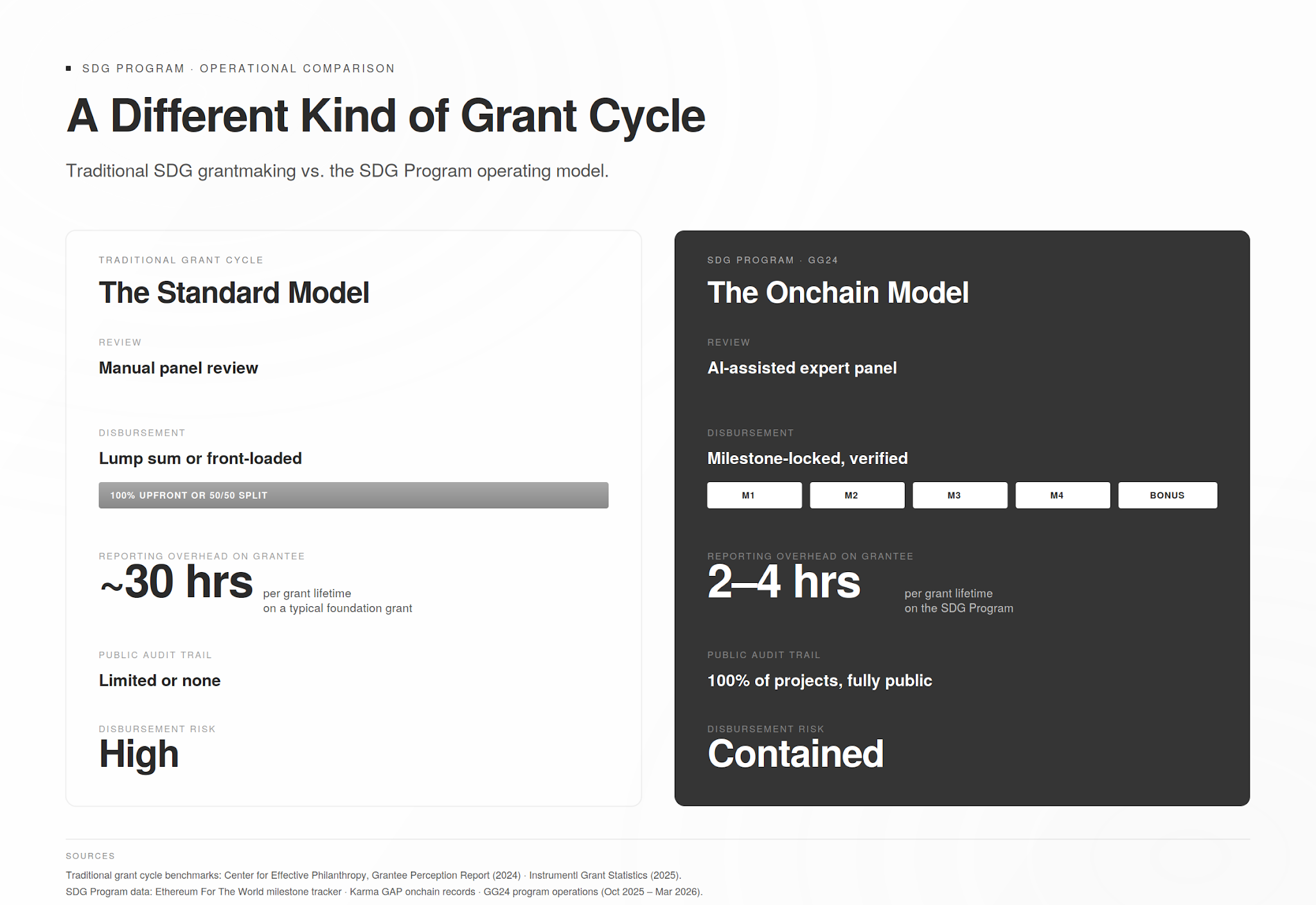
A side-by-side view of how the SDG Program model compares to traditional grantmaking on review, disbursement, reporting overhead, audit trail, and risk.
The trio below spans digital institutions, climate accounting infrastructure, and on-the-ground government adoption — three categories any major funder cares about.
Grant: $17,500 · Score: 8.5 · Status: Completed
The value proposition: Trustworthy digital voting that scales to populations, not just DAO committees.
DAVINCI is a next-generation voting protocol from Vocdoni, a team that has built electoral infrastructure for civil society organizations for years. The protocol delivers cryptographically verifiable, gasless, privacy-preserving elections at a population scale, addressing the long-standing tradeoff between privacy, cost, and verifiability that has kept onchain voting confined to crypto-native use cases.
The grant funded core protocol development, with the largest single milestone ($7,000) tied to the most technically demanding component. View their completion thread on X.
Relevance to SDG 16: Election infrastructure that any citizen, observer, or international monitor can independently verify is a public good with obvious institutional demand — from civil society referenda to municipal participatory budgeting to internal NGO governance.
Grant: $12,500 · Score: 8.3 · Status: Completed
The value proposition: A shared standard so impact claims from different programs can be verified, reconciled, and aggregated — eliminating double-counting and making MRV (Monitoring, Reporting, Verification) cheaper.
A reforestation project in Kenya, a soil-carbon program in Brazil, and a watershed initiative in Indonesia produce impact data in incompatible formats today. This forces every funder to build bespoke verification pipelines and makes portfolio-level outcome reporting nearly impossible. The Regen Claims Engine builds an open, modular standard that lets any platform issue, verify, and reconcile impact claims through a shared protocol.
Direct relevance for funders: Any organization currently funding nature-based solutions, climate adaptation, or impact-linked finance is paying — explicitly or implicitly — for verification overhead. Shared infrastructure reduces that cost across the entire sector.
Grant: $7,500 · Score: 7.5 · Status: Completed
The value proposition: A national government using verifiable, open, onchain-compatible infrastructure as the foundation for its agricultural and climate strategy.
BhuSIS is a state-led initiative replacing the global default soil datasets Bhutan had historically relied on with a comprehensive, locally-generated national soil atlas — aligned with FAO's Global Soil Information System and the International Soil Reference and Information Centre. The system feeds directly into Bhutan's 13th Five-Year Plan, which targets bringing 15,220 acres of farmland under sustainable land management to combat topsoil loss averaging 6.42 tonnes per hectare per year on agricultural slopes.
The grant supported the project's onchain extension — connecting BhuSIS soil data to verifiable, tamper-evident records suitable for cross-border trade, climate finance, and international compliance reporting. The underlying engineering question — how do you prove a farm or forest exists, and that the data describing it has not been altered, when the location lacks reliable internet? — is precisely what Ethereum-class infrastructure is built to answer.
Relevance for institutional funders and multilaterals: When a sovereign ministry chooses public, auditable infrastructure for national-level resource management, it creates a reference architecture other governments can adopt. This is the kind of precedent that turns isolated pilots into sector standards.
Most blockchain for good pitches ask grantmakers to take a leap of faith. The SDG Program is the opposite: a documented, auditable example of an operational improvement to how grants can be selected, disbursed, and verified.
Three takeaways worth holding on to:
The 101% deployment rate, 84% full-completion rate, and 100% public-audit coverage are evidence that these design choices, taken together, produce better outcomes than the standard grant cycle.
The full SDG Impact Report is being finalized and will inform the next generation of ETH FTW initiatives. While no new projects are confirmed yet, however we are actively looking for partners to design Tech for Good and Ethereum development programs.
For NGOs, foundations, and program operators interested in adapting any element of this structure — the milestone framework, Karma GAP integration, AI-assisted review — Ethereum For The World is actively partnering with organizations to do exactly that.
Get in touch: eth@fortheworld.eco · @ETHForTheWorld
See how Ethereum powers local solutions tackling climate, equity, and more on the ground and at scale.






%20(1).jpg)
.png)